Adaptation
In color adaptation, our visual system’s interpretation of any light source as white after a minute or two.
After Images
Seeing a green spot on a white wall after staring at a red one is one of the first color vision tricks learned in school. More profoundly, it illustrates our vision’s use of contrast in color recognition.
Airglow
Photochemical luminance visible in the night sky.
Air-light
This is sun light diffused and scattered, that is, bounced around in all directions, by air molecules and particles in our atmosphere, called aerial perspective by artists, this haze lessens the contrast between objects in the distance and makes them seem bluer and farther away from us.
Alpenglow
The red glow on mountain peaks when illuminated by the direct low sun, and the purple glow of the landscape after sunset.
Architecture
I like to think of its aesthetic dimension. As our shelters attain a level of integrity, balance and realization of their aims, we describe them as architecture.
Architectural Color
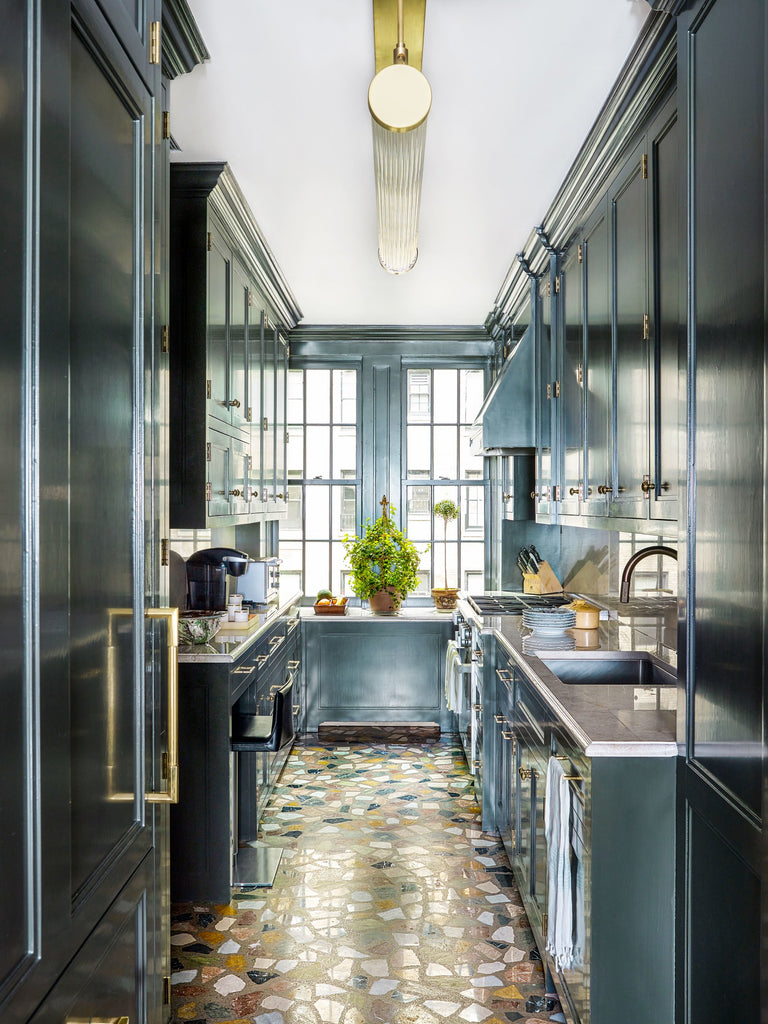
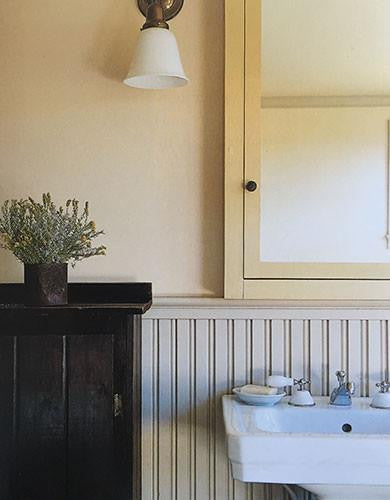
The frosting on the architectural cake.
Atmosphere
The gases and particulate matter surrounding the earth by which radiant energy from the sun is scattered into the colors we see in the sky. “When we look at the objects around us, whether in a landscape or an interior, we notice that between each of them there is a kind of connection produced by the surrounding envelope of air and the various reflections which, as it were, cause each separate object to be part of a general harmony.” The Journal of Eugene Delacroix Paris 25 January 1857.
Balance
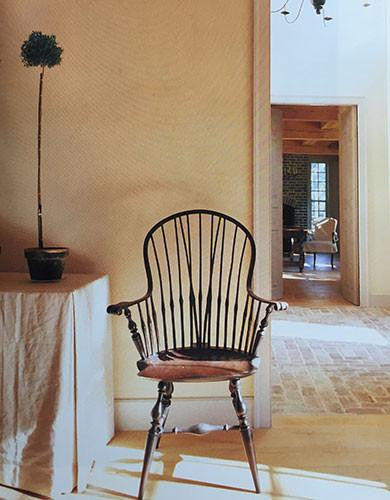
Balance in decoration is usually noticed by its absence. The key to balancing a room’s color is recognizing that architectural color is made up equally of color and space.
Beauty
In vision, fulfillment, according to our criteria.
Black
The first color. Often described as the absence of color, true black is definitely a color, but like white, it doesn’t have a hue.
Blue
The color which is stronger in dim light than it is under bright illumination. Think of blue flowers in the garden at twilight.
Brightness
Perceived lightness. Making a space feel full of light is different from making it light.
C.I.E.
Commission International d’Eclairage: The body governing color formulation worldwide.
Cinema
Rooms are global experiences, existing, like we do, in three-dimensional space. We look around rooms. Our vision is always moving. It is more cinematic than static.
Colors
Some say humans have the potential to discern one million and others say eight to ten million.
Color Chips
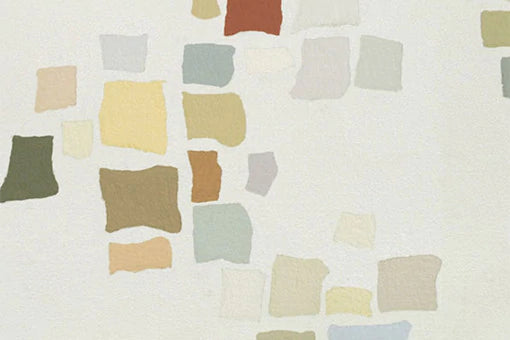
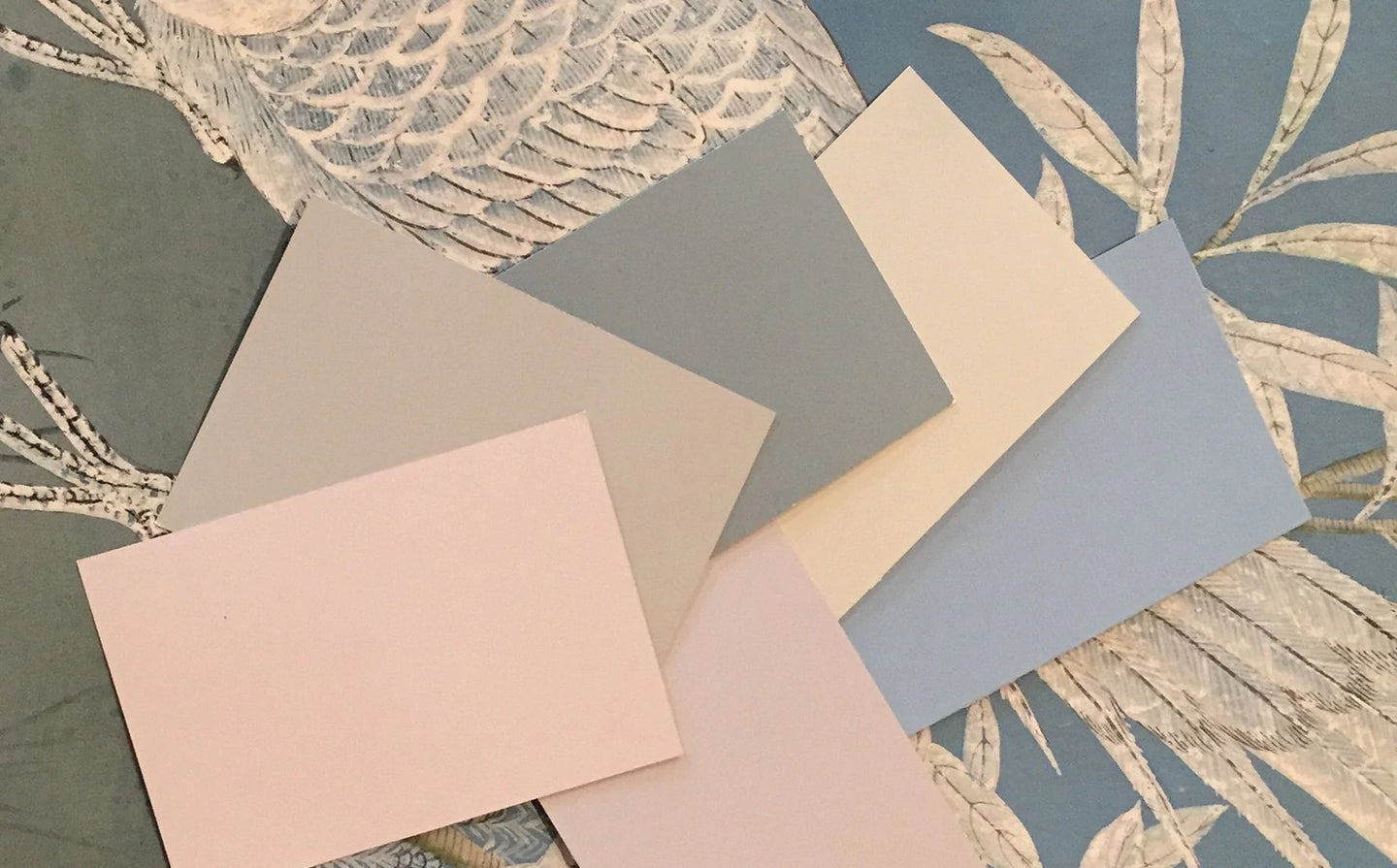
Going directly from a chip on the rack to paint on a wall can be perilous.
Color Constancy
Our vision is wired so we see the color of an object unchanging despite changes in the color of the light illuminating it.
Color Consultant
Like all consultants, an individual who gets paid for asking questions.
Color Field
Coined by art critic, Clement Greenberg to describe paintings with subtly modulated and barely differentiated colors across large surfaces.
Color Scheme
When scheming, what is the end game?
Color Sensations
This reminds us that color is not concrete, but something we only experience as sensory interpretations by each of our individual visual systems.
Color Vision
The complex mechanisms by which electromagnetic energy is converted to our impressions of hue.
Colloidal Suspension
The state in which pigments are held in the liquid paint vehicle without dissolving.
Complement
According to the dictionary, that which makes up a deficiency. In color, think of the rainbow. Take one of the spectral hues away. The one taken away is the deficiency. The rest of them mixed together make the complement of the one taken away. Add them back together and you have the full rainbow. The deficiency has been made up, and the spectrum is whole.
Complex
In commercial paint color, a marketing term used to imply aesthetic quality.
Computers
Computer color matching is no substitute for creating a color with the human eye.
Contrast
The mechanism by which our vision interprets our world. Human vision is always drawn to the strongest contrasts of light and dark, even before contrast of color hues. When that contrast is absent and the values are close, we see surfaces of rooms as more atmospheric, akin to the way we see the constantly mingling amor- phous pinks, grays, and whites of clouds and moisture particles in the sky. See Color Field and Atmosphere.
Context
The earth to the sky, the house to the landscape, the floor to the ceiling, the individual to the society.
Depth
In architecture, an illusion of penetration of surfaces.
Dinosaur
Think about, to make color decisions relaxed.
Emotions
Rooms are not just a collection of windows and floors. They are also atmospheres of color and light that elicit emotional states at the same time they define our physical surroundings.
Finishes
In paint, usually describing the sheen and texture of the surface as opposed to its color.
Floors
The element of spaces most often left out of the decorating calculations, but one which has major effects on the palette through contrast and reflection.
Fluorescent
Light created by an electric current exciting phosphors. Poor color rendering compared to incandescent and natural daylight, but better than high-intensity-discharge sources like metal halide or mercury vapor.
Framing Devices
Cards with cutouts used to frame a scene, allowing the viewer to focus on color relationships without the distractions of the surroundings.
Full Spectrum
The sun not only produces the shortest and the longest lengths of radiant energy, but also every variation in between. We label this spectral range as full because the sun’s flux isn’t leaving any wavelengths out. Any continuous burning filament gives us the same continuous spectral range except the lower the temperature the redder the emphasis. When the temperature is high enough, we begin to experience whiteness. In sunlight and ordinary light bulbs the wavelengths vary continuously, but fluorescent and other sources like the metal halide we see in car showrooms and shopping malls leave parts out. The “full-spectrum” fluorescents mandated by energy efficiency are not continuous. They create the illusion of fullness but fall short of key benefits for human well-being.
Glaze
A transparent paint applied over a solid background.
Gloss
The degree to which surfaces are smooth and therefore reflective. See High-gloss.
Gothic Churches
Structures devoted to the transformation of light into spirit.
Gradation
A useful term for considering variations of hues and values playing across architectural surfaces by slow degrees. Designers organize gradations with regular progressions: our vision organizes gradations by light and shadow.
Gray Scale
A tool showing regular intervals of grey from light to dark used in architectural training. This is logical because our vision places more importance on differences of dark and light (value) than on differences of spectral distribution (color hue).
Green
Incorporating the cool of blue and the heat of yellow, green’s reach is broader than anything else in the spectrum. This dual personality enables it to be as effective as a backdrop in living spaces as it is in the landscape. Hunter, celadon, and khaki were used in many historic houses as a bridge between nature and architecture.
Harmony
You might think of the surfaces of a room as a kind of instrument of light sending information to your eyes the way a piano keyboard sends vibrating sound waves to your ear. In the same way that a composer calls forth bass or treble notes, chords and variations, you can compose a room’s depth by carefully determining the texture, pigments, and sheen of its walls.
H.I.D.
High intensity discharge lamps are the poorest color rendering artificial light sources. One type, metal halide, is used in car showrooms to exploit metallic color coatings and emphasize automobile’s sculpted profiles. Sodium is used in parking lots and explains why red cars are hard to locate.
Hierarchical systems
Architects use consistent intervals of measure because humans are comfortable with regular progressions. Hierarchical systems are the proportional underpinnings that interconnect all the elements throughout all the rooms: the proportions and size intervals of trim to walls, of hallways to rooms, of various doors and ceiling heights to one another, of wood to plaster, to tile.
High Gloss
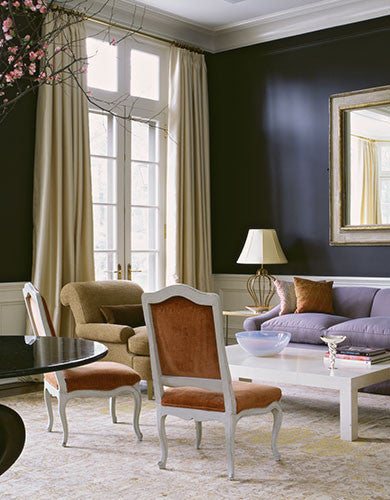
Because of its expense, the most underused and under-appreciated paint treatment. The only difference between a flat and glossy surface is texture.
Hue
The attribute of a color by virtue of which it is discernible as red, green, etc., and which is dependent on its dominant wavelength, and independent of intensity or lightness.
Incandescent
Continuous spectrum illumination produced by a burning filament. Although redder than daylight, this is the best color rendering artificial source.
Inorganics
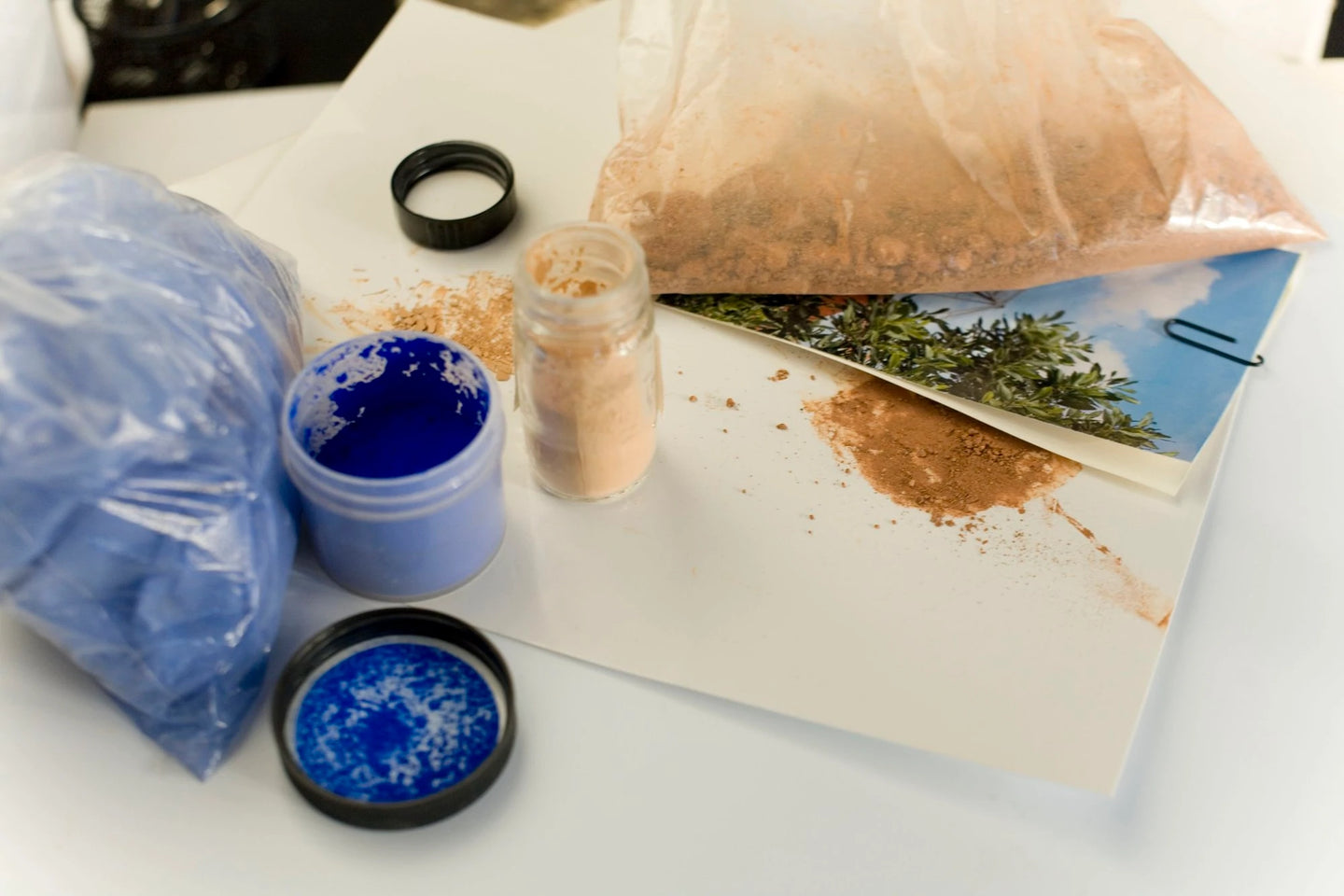
In paint pigments, they are known as earth colors. But almost all inorganics are now synthesized chemically. Being cheaper and more opaque than the transparent and brighter organics, they account for tinting most commercial paint. See Organic Pigments.
Instinct
Color choices are often influenced by trends, fashions, persuasive friends, or by the casual comment of a stranger, but the ones stemming from instinct will provide long-term pleasure.
Intensity
Another description of saturation, independent of hue or lightness. I like thinking of intensity as how much of the color is in the color.
Involuntary Vision
Regardless of where we choose to look, our eyes are recording color sensations in wide fields of view.
Kelvin temperature
The higher the number, the bluer the light. Incandescent light is about 2700 degrees, halogen 2750 to 2900, fluorescent 2750 and up to 3500 for offices, average daylight 6500 to 7500.
Light
Visible electromagnetic radiation.
Lighting
Not just what illuminates. It is the balance of all the different sources of illumination, indoor and outdoor, natural and man-made, adding up to the overall ambiance, modulated by pools, shadows, and sparkle.
Light Sources
If the light source doesn’t have red, neither will the tomato. Try to find your red car in a parking lot illuminated by sodium lamps. See Incandescent, Fluorescent, and H.I.D.
Light Waves
I find lakes helpful in envisioning how light produces our color sensations. Think of a lake’s waves as flowing radiant energy. A choppy surface and shorter lengths between peaks give us the sensation of blueness. With smoother water the longer length waves elicit impressions of red. Thus we sense blue on one end of our sensitivity and red on the other, along with their combination as violet mysteriously linking the extremities.
Luminance
Perceived lightness. It is totally relative. It has nothing to do with how much candlepower there is, but rather, how we adjust the range of brightness. Humans are most comfortable in a narrow range of luminance.
Luminescence
Any non-thermal emission of light.
Luminous
The appearance of emitting radiant energy. Because of their resemblance to burning light sources, reds, oranges and yellows appear more luminous than cooler hues.
Metamerism
This term is commonly misused, describing a color that changes according to the light. It is actually the property of two colors, which appear to match under one light source, but which are dissimilar under another.
Neutral
A neutral does not have to be a shade of white, beige, or gray. It need appear neither pale nor colorless. What it does require is a balance of warm and cool tones so that it can, in context, function as a color from either end of the spectrum. It will often be as deep or light as the objects it surrounds. Like a good understudy, a neutral can always take over any role.
Nourishment
Among the most critical for humans is sunlight.
Opaque
A paint that completely hides the color of the surface over which it is applied.
Organic Pigments
The opposite of pesticide free naturally grown foods, organic pigments are usually synthesized chemically, and account for the pure spectral pigments used in paints.
Particulate Matter
Solids of various sizes suspended in our atmosphere. From natural and man-made activity, these elements create the colors of the sky, and the character of the sunlight by which our environment is illuminated.
Patina
Any kind of surface oxidation is a trace of the past and a dialogue with the elements, whether on a fence or a face.
Peripheral Vision
When we turn to face something, the area of concentration is only a small fragment of what we perceive. Much of our impression of a space actually occurs at the margins. Below the threshold of consciousness, peripheral vision is one of the most under-exploited tools we have.
Pigment
Strictly speaking, pigment and color are synonymous.
Primers
No matter how good the coverage, paints are not entire- ly opaque. Our colors full impact only results when they are applied over white primer.
Professional Designer
For the full realization of our living spaces, expertise matters. Good decorators incorporate architectural structure, and good architects know the importance of the surfaces by which their structures are revealed.
Quality
Our pigment blends are designed to realize the greatest depth of each color they render.
Realization
Understand that good art and design are ultimately about profound realization, not about snob appeal.
Red
The warmer the red, the more red it is perceived to be. While red resists being anything but red, it also serves wonderfully well as a neutral.
Reflection
Since we can’t look straight at the sun, or effectively at artificial light sources, everything we see is only by reflected light. This fact reinforces the importance of walls and ceilings and the reflecting surfaces, which determine the color sensations of our living spaces.
Refraction
The bending of light (rays) passing from one medium to another, as from air into water.
Relativity
Color is elusive. Color is relative. Any attempt to generalize about it is dangerous. Staying focused on color’s ungraspable nature may be the best way to grasp it.
Saturation
I believe this is a more accurate way to describe the amount of color in a color than the more commonly used, “intensity”.
Scale
Scale is more than how big the furniture should be. It is the flood of sensation our bodies feel in the spaces surrounding us.
Scattering
The action by which radiant energy is reflected.
Shadows
The areas out of the direct illumination of the light source, whose colors we see as a result of the environment’s reflected light.
Snow
The whitest surface in nature.
Sources
There are palettes of architectural balance and regional appropriateness to be found in the twigs, leaves, stones, and earth within ten feet of the back door.
Swatch
Beware of the swatch on the wall. If you are looking at a paint sample surrounded by white primer, floating midway between base and crown molding, you will not see its true effect in the room. Prove this to yourself by painting a swatch twice as big on the wall to the left and one double that size on the wall to the right. As the samples enlarge and the contrast with the white primer moves out of your center view, the color appears both lighter and more intense. See The Painting Project.
Transitions
As our vision sorts out the world, edges are more important than what they contain, so in room-to-room schemes, note where colors change.
Translucent
The quality of partial transparency, which gives leaves and grasses great depth as light filters through them.
Trends
In color, preferences for certain ranges created by groups of manufacturers to insure compatibility of palettes of goods with long lead times.
Texture
The nature of the surface exerts a strong influence over color. No matter how shallow the depth, all patterns and relief create shadows. Textures, whether natural or man-made, can cause the light to reveal colorful interplay simply by revealing their yellow sides on surfaces and blue-violet tones in the recesses. No matter how large, samples that don’t duplicate the textures of actual surfaces, will not lead to an accurate projection. For both interiors and exteriors we make sure the paint tests go on surfaces that replicate the finished product. See High-Gloss.
Transcendence
Once physical survival is ensured, all cultures seek spiritual dimensions... organizing aspects of the appearance of light and color in nature... it’s important to recognize that thoughtfully crafting this kind of balance and luminosity can give us the same spiritual or aesthetic dimension in our homes.
Turner, J.M.W.
Turner, J.M.W. applied same value washes of red, yellow and blue to his water color paper in order to simulate the full spectral range of natural daylight.
Value
The lightness and darkness of things, apart from what color we see them as. Light vs. dark. Brightness is more descriptive. When values are close they create the illusion of atmospheric mist and depth, reminiscent of the way objects in the landscape look from a great distance. See Air-light.
Viewing angle
A crucial factor in how colors on surfaces are perceived.
Violet
If red feels the most tangible of colors, violet is the most ephemeral, nearly always about to evaporate. As the complement to yellow sunlight, violet is the most obvious color of shadows.
V.O.C.’s
Volatile Organic Compounds.
White
White is not romantic to talk about. It doesn’t reproduce well. Compared to red and blue, the pigment history of white is boring. Lime and chalk don’t conjure the same dreamscape as cochineal beetles crushed into red or lapis ground to ultramarine. But white, with its vast range encompassing tens of thousands of perceptible shades, has many hundreds of paint possibilities.
Yellow
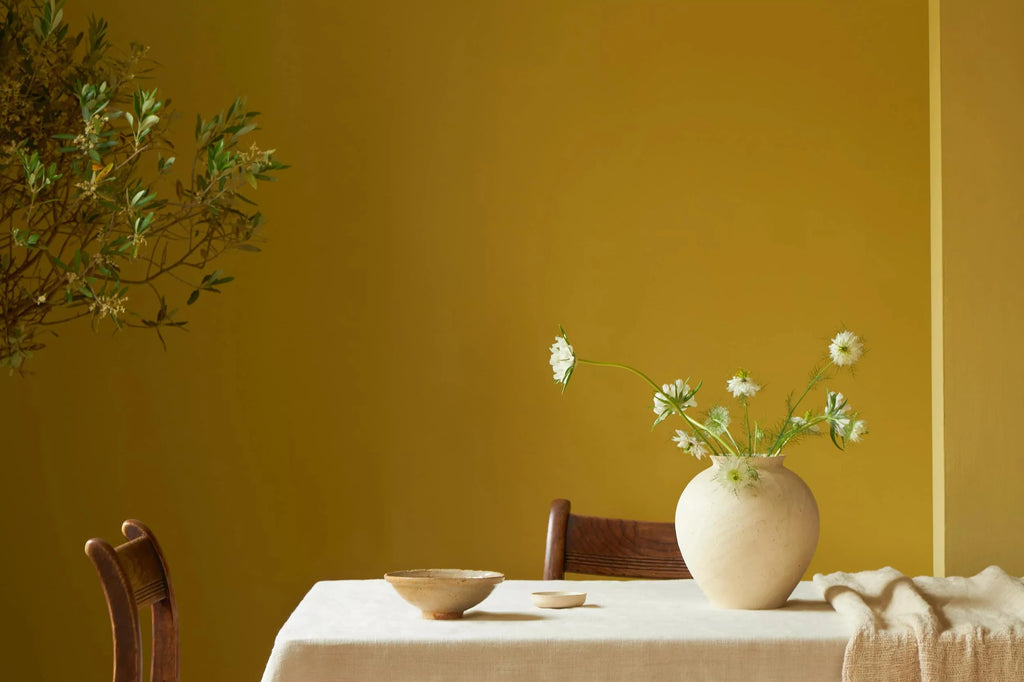
Falling between the extremes of red and violet, yellow seems closest to visible light: we perceive it as if it were sunshine itself. Much like the sun, yellow appears to illuminate other hues. Our eyes are always drawn to a source of light.
Zero V.O.C.’s
Used to advertise environmentally friendly paint, but for water base acrylics “Zero” means less than 15.